

Our team has spent nearly two decades in nephrology care. If there is one thing that has stayed with us throughout our work, it is the helplessness we feel when we sit across from a patient whose kidneys are quietly failing — with nothing to offer but a slow countdown to dialysis.
Let us tell you about Mr. Chen. He came to our partner hospital three years ago, a 58-year-old retired factory worker from Sichuan. He had diabetes for fifteen years, hypertension for twelve, and he had never once checked his kidney function. His routine blood work showed a creatinine of 2.8 mg/dL and an estimated glomerular filtration rate (eGFR) of 32 mL/min/1.73m² — stage 3b chronic kidney disease. He was not in crisis yet, but the trajectory was clear. I told him to watch his diet, to control his blood pressure, to take his medications. And I told him to prepare for the possibility that within three to five years, he would need to start dialysis.
He looked at us with a kind of quiet resignation that we have seen a thousand times. He asked us, “Is there really nothing else?”
At the time, we had no good answer. Today, we do.
What Is Chronic Kidney Disease — and Why Does Early Intervention Matter?
Chronic kidney disease (CKD) is defined as abnormalities of kidney structure or function that persist for more than three months, with implications for health. It is a progressive condition, and once kidney function declines beyond a certain point, the damage is largely irreversible. The kidneys lose their ability to filter waste products, regulate fluid balance, maintain electrolyte homeostasis, and produce hormones essential for red blood cell production and bone health.
The numbers are staggering. According to the 2025 Global Kidney Health Atlas, the global prevalence of CKD has reached 14.2%. In China, more than 130 million adults are living with CKD, yet the awareness rate remains extremely low — only about 14.8% of patients know they have the disease. The prevalence in China is estimated at approximately 10.8%, meaning roughly one in ten adults is affected. And the disease is accelerating: the annual incidence of end-stage renal disease (ESRD) continues to grow at a rate of 8.5%.
Why is CKD so dangerous? Because it is the ultimate “silent killer.” The early symptoms of kidney disease are often subtle, and the condition progresses silently. Many patients can lose more than 50% of their kidney function before experiencing any noticeable symptoms. By the time they seek medical attention — often triggered by fatigue, edema, or incidentally discovered abnormal lab values — the disease has already advanced to a stage where conservative management is no longer sufficient. Once patients reach ESRD, the only options are dialysis or kidney transplantation. The average survival time for dialysis patients is five years. The burden on families, healthcare systems, and patients themselves is immense.
This is why early detection and timely intervention are not just clinical recommendations — they are imperatives. The 2023 KDIGO Clinical Practice Guideline for the Evaluation and Management of CKD emphasizes that the core principle of kidney disease prevention and treatment is “early detection, early diagnosis, and early treatment”. But for patients like Mr. Chen, who already have established CKD, early detection is no longer enough. They need therapies that can actively slow — or even halt — disease progression.
Until recently, our therapeutic arsenal for CKD was limited. We had blood pressure control, ACE inhibitors or ARBs, SGLT2 inhibitors, dietary modifications, and lifestyle changes. These interventions slow progression, but they do not reverse it. They do not restore lost kidney function. They do not repair damaged renal microvasculature. And they certainly do not give patients the hope of delaying dialysis by a meaningful margin.
That is precisely where Nephrospec changes the equation.
Nephrospec: A New Paradigm for CKD Treatment
On May 20, 2025, the international, cutting-edge Nephrospec kidney shockwave therapy device was officially installed at West China Lecheng Hospital in the Boao Lecheng International Medical Tourism Pilot Zone. This marked the first time this technology became available to patients in China. And for those of us who have long awaited a non-invasive, mechanism-based therapy for CKD, it felt like the beginning of a new chapter.
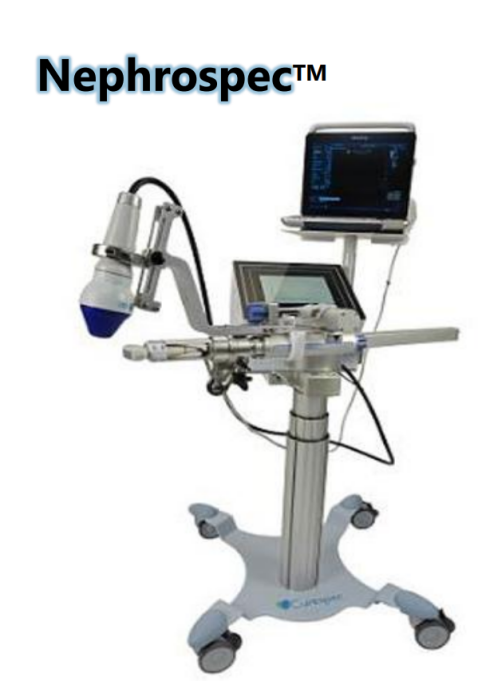
Nephrospec is a low-intensity extracorporeal shockwave therapy (Li-ESWT) system developed by the Israeli company Curespec. It is intended for the combined treatment of chronic kidney disease and hypertension. The device delivers controlled acoustic pulses that are focused on the kidneys, promoting new blood vessel formation, restoring damaged tissue function, and reducing oxidative and fibrotic damage.
To understand why this therapy works, it helps to review the pathophysiology of CKD progression. One of the key drivers of declining kidney function in CKD is microvascular rarefaction — the loss of small blood vessels in the kidney. This leads to chronic hypoxia, which in turn triggers fibrosis, inflammation, and further loss of nephrons. It is a vicious cycle, and traditional pharmacotherapy does little to break it.
Nephrospec targets this cycle directly. The low-intensity shockwaves stimulate the endothelium to release vascular endothelial growth factor (VEGF) and nitric oxide, promoting angiogenesis — the formation of new blood vessels. They also activate endogenous stem cells, facilitating tissue repair and regeneration. Animal studies have demonstrated that Li-ESWT reduces renal inflammation and fibrosis, increases VEGF and endothelial cell proliferation, and improves renal vascularization and perfusion. The result is improved kidney oxygenation, preserved renal function, and — crucially — delayed progression to ESRD.
How Does Nephrospec Differ from Traditional High-Intensity Shockwave Lithotripsy?
Many patients hear the word “shockwave” and immediately think of lithotripsy — the high-intensity shockwave therapy used to break kidney stones. But Nephrospec is fundamentally different.
Traditional lithotripsy uses high-energy shockwaves — typically around 0.5 to 1.0 mJ/mm² — to fragment renal calculi. These shockwaves are powerful enough to shatter solid stones, but they also carry risks: renal hematoma, parenchymal injury, and transient declines in renal function. Nephrospec, by contrast, delivers shockwaves at a much lower intensity — over 20 times weaker than those used for kidney stones. In fact, the energy used in Li-ESWT is only approximately 10% of that used in lithotripsy.
This lower intensity is not a limitation; it is precisely the point. At these energy levels, the shockwaves are no longer destructive — they are therapeutic. They stimulate biological responses without causing tissue damage. The treatment is non-invasive, painless, and requires no anesthesia. Patients can undergo the procedure in an outpatient setting and return to their normal activities immediately afterward.
Another key difference is the treatment protocol. Nephrospec is administered as a series of six sessions over three weeks — two sessions per week. Each session delivers approximately 2,400 shockwaves to each kidney. The entire course is completed in less than a month, and the therapeutic effects — improved blood pressure control, stabilized renal function, and reduced need for medication — can persist for months or even years.
Perhaps most importantly, Nephrospec addresses the root cause of CKD progression — microvascular dysfunction — rather than merely managing its downstream consequences. This is a fundamental departure from the symptomatic approach that has dominated CKD care for decades.
Treatment Principles, Clinical Efficacy, and International Accreditations
The therapeutic mechanism of Nephrospec is grounded in robust preclinical and clinical evidence. The technology, known as electro-hydraulic acoustic therapy (eHAT), was first introduced in the field of nephrology in 2016, when it received CE mark approval in the European Union. Since then, it has been studied in multiple clinical trials across several countries.
In human studies involving patients with diabetic nephropathy, six to twelve sessions of Li-ESWT have been shown to lead to long-term reductions in blood pressure and stabilization of renal function, as measured by eGFR. Preliminary clinical studies in patients with stage 3a/3b CKD have demonstrated significant blood pressure reduction, decreased medication burden, and measurable improvements in renal function, with no serious treatment-related adverse events. A 12-month follow-up study published in the Journal of Hypertension confirmed that eHAT is a tolerable and safe procedure, and that a three-week regimen tends to reduce blood pressure and preserve eGFR in patients with hypertension and CKD.
Perhaps the most compelling clinical outcome is the delay in dialysis initiation. Clinical data have shown that Nephrospec treatment can effectively delay the need for dialysis by more than one year. For patients with stage 3 or 4 CKD, this means an additional 12 months of life without the constraints, complications, and quality-of-life sacrifices imposed by dialysis. In a healthcare system where the average annual cost of dialysis exceeds 100,000 RMB per patient, the economic implications are equally profound.
Nephrospec has received regulatory approvals from some of the world’s most stringent health authorities. The device is CE-marked under the European Union’s Medical Device Directive. It has also received AMAR approval from the Israeli Ministry of Health. In Thailand, Nephrospec has received Thai FDA approval and is the only such device on the market in that country. The device has been used in clinical settings across Europe, Israel, Australia, and other regions. The manufacturer operates under ISO 13485 quality management standards, and the device holds a granted U.S. patent for its proprietary shockwave technology.
Importantly, Nephrospec is not an experimental device. It is a market-ready product with a strong intellectual property portfolio, supported by clinical data from multiple centers and a growing body of peer-reviewed literature. Its safety profile has been well established through years of post-market surveillance.
Why Lecheng? Why West China Lecheng Hospital?
The Boao Lecheng International Medical Tourism Pilot Zone was established in 2013 as China’s only national-level medical special zone, authorized by the State Council to expedite the import and clinical application of innovative medical devices and drugs that have not yet received full NMPA approval. Lecheng operates under a “first-pilot, first-use” policy: if a therapy is already approved by a major international regulatory authority — such as the CE mark or FDA — and if it addresses a critical unmet clinical need in China, the zone can authorize its limited clinical use at designated hospitals.
West China Lecheng Hospital is a collaborative project between Sichuan University, Hainan Holdings, and the Lecheng Administration. It is the Hainan branch of West China Hospital, one of China’s most prestigious academic medical centers. The hospital has the clinical infrastructure, regulatory oversight, and specialized expertise to deliver this therapy safely.
For patients like Mr. Chen, this means access to a world-class innovation without the need to travel overseas. It means receiving treatment at a facility affiliated with a top-tier Chinese medical institution, under the supervision of physicians trained in the latest evidence-based protocols.
A Call to Action: Let Us Change the Trajectory of Your Kidney Disease
We think about Mr. Chen often. He completed his course of Nephrospec treatment at West China Lecheng Hospital three months ago. His eGFR has stabilized. His blood pressure is better controlled with fewer medications. And for the first time in years, he told us, he feels like he has some control over his own future.
He said at our last follow-up, “I used to wake up every morning thinking about dialysis. Now I wake up thinking about my grandchildren.”
That is what this technology represents. It is not a cure. CKD remains a chronic, progressive disease, and we cannot promise that Nephrospec will work for everyone. But it is a genuine breakthrough — the first non-invasive, mechanism-based therapy that directly addresses the microvascular pathology underlying CKD progression. It is backed by rigorous clinical evidence, approved by multiple international regulatory authorities, and now available in China for the first time.
If you or someone you love has been diagnosed with stage 3 or 4 chronic kidney disease — particularly if you have hypertension as a comorbidity — we invite you to consider whether Nephrospec might be right for you. The treatment is non-invasive, performed in an outpatient setting, and completed in just three weeks. The potential benefits — stabilized kidney function, reduced medication burden, and delayed progression to dialysis — are substantial.
To learn more, please contact our nephrology service at West China Lecheng Hospital. Our team will review your medical history, including your most recent eGFR, blood pressure, and medication regimen, and determine whether you are a suitable candidate. We are here to answer your questions about the treatment, the travel arrangements to Hainan, and the costs involved.
You do not need to accept a slow countdown to dialysis. There is another path. Let us walk it together.
