

China's First Leonardo-Guided Knee Nerve Radiofrequency Ablation Performed at Ruijin Hainan Hospital in Lecheng
On September 16, 2026, a multidisciplinary surgical team at Ruijin Hospital Hainan Hospital (Ruijin Hainan Hospital) successfully completed China’s first knee joint peripheral nerve radiofrequency ablation procedure using the German semiconductor laser system Leonardo and the PLDD Kit light-energy ablation catheter set. The procedure was performed jointly by the orthopedics team of Chief Physician Wang Guangji from Hainan General Hospital, the orthopedics team of Associate Chief Physician Zhang Yin from Ruijin Hainan Hospital, the anesthesiology team of Chief Physician Zhang Haiyan, and the operating room nursing team led by Head Nurse Yu Rongqian.
The Clinical Context: When Conservative Care Is Not Enough
Knee osteoarthritis is one of the most common chronic conditions affecting middle-aged and elderly populations, and a leading cause of chronic pain and reduced mobility. Lumbar disc herniation is similarly prevalent, with many patients developing secondary foraminal stenosis that leads to radiating nerve pain and limb numbness. As China’s population ages and sedentary lifestyles become more widespread, the incidence of spinal-origin pain and degenerative joint disease continues to rise.
Current treatment options each carry significant limitations. Medications and physical therapy provide only temporary symptomatic relief. Corticosteroid injections require repeated needle punctures. Conventional radiofrequency ablation offers limited controllability over thermal injury. Open surgery and joint replacement are invasive, with long recovery periods. Many patients who fail conservative treatment are not suitable candidates for open surgery, creating an urgent need for safe, effective minimally invasive alternatives.
Leonardo Semiconductor Laser and PLDD Kit: Technology Overview
The Leonardo semiconductor laser system is a German-engineered medical device that converts electrical energy into laser radiation through gallium arsenide semiconductor technology. It received its first clinical application in mainland China at Ruijin Hainan Hospital and obtained approval for use within the Lecheng Pilot Zone on June 24, 2026. The Leonardo laser’s approved indications include contained lumbar, cervical, and thoracic disc herniation, discogenic pain, lumbar spinal stenosis, and sacroiliac joint denervation. Internationally, the Leonardo platform has a broader range of applications spanning orthopedics, neurosurgery, ENT, pulmonology, gastroenterology, proctology, phlebology, dermatology, urology, gynecology, and plastic surgery, with orthopedic indications including contained lumbar and cervical disc herniation, discogenic spinal stenosis, discogenic pain syndrome, and chronic facet and sacroiliac joint syndrome.
The PLDD Kit (Percutaneous Laser Disc Decompression Kit) is a companion device developed by biolitec of Germany. It functions as a light-energy ablation catheter set that transmits laser energy through optical fibers to the intervertebral disc or joint nerve under minimally invasive surgical conditions, precisely targeting the lesion site for therapeutic effect. The PLDD Kit’s approved indications include contained disc herniation of the lumbar, thoracic, and cervical spine, secondary foraminal stenosis (Stages I and II), chronic joint syndrome, and sacroiliac joint syndrome.
Both devices are not yet commercially available in mainland China. They are approved for use exclusively within the Lecheng Pilot Zone under its special access policy, which allows innovative medical devices already approved by major international regulators—in this case, the European Union—to be used clinically before full national registration.
The Procedure: Precision at the Millimeter Scale
The patient presented with right knee osteoarthritis and chronic knee pain that had not responded adequately to conservative measures. The surgical team’s objective was to perform selective radiofrequency ablation of the peripheral nerves surrounding the knee joint—specifically targeting the small sensory nerve branches that transmit pain signals from the joint capsule and surrounding soft tissues—while preserving motor function and avoiding damage to major vessels and nerves.
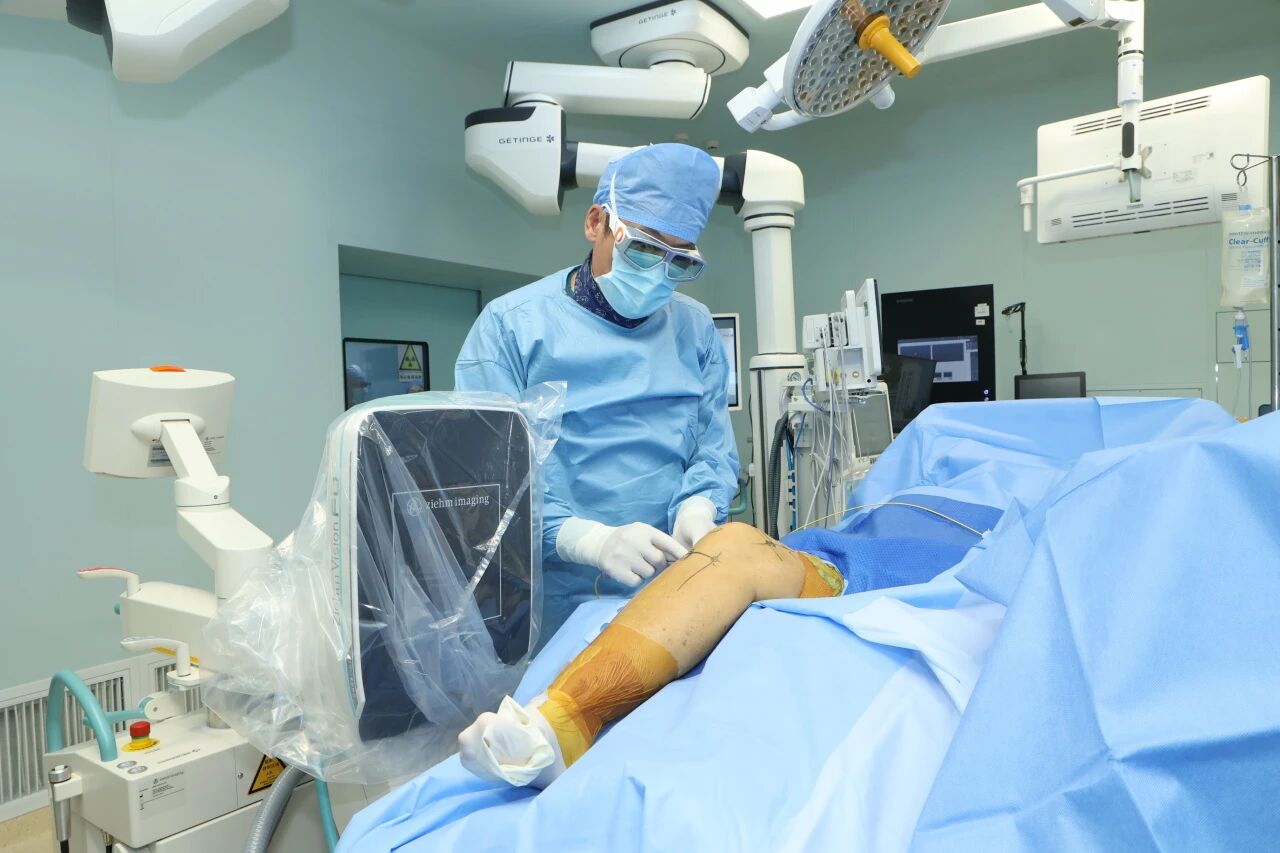
The procedure began with the patient under appropriate anesthesia. The surgical team used the Leonardo semiconductor laser system in conjunction with the PLDD Kit to deliver controlled thermal energy to the target nerve branches. The key to the procedure was precision: the laser energy had to be delivered at the correct depth and in the correct distribution to achieve adequate denervation without causing unintended thermal injury to surrounding tissues. The Leonardo system’s dual-wavelength capability and the PLDD Kit’s specialized fiber design allowed the team to tailor the energy delivery to the specific anatomy of the patient’s knee.
The entire procedure was performed percutaneously, meaning no open incision was required. The patient tolerated the procedure well and showed no immediate complications.

Advantages Over Conventional Treatments
The Leonardo and PLDD Kit approach offers several meaningful advantages over traditional modalities for knee osteoarthritis and spinal pain:
Precision. Conventional radiofrequency ablation has limited controllability over thermal spread. The Leonardo system allows the surgeon to adjust wavelength, power, and pulse duration in real time, enabling more precise targeting of the affected nerve branches with less collateral thermal damage to surrounding tissue.
Minimal invasiveness. The procedure is percutaneous, requiring only a small puncture rather than an open incision. This translates to less postoperative pain, faster recovery, and a lower risk of infection and scarring compared with open surgery or joint replacement.
Reduced need for repeated interventions. Unlike corticosteroid injections, which typically provide temporary relief and require repeated administration, nerve radiofrequency ablation offers the potential for longer-lasting pain relief by disrupting the pain signal pathway at the source.
Applicability to patients unsuitable for open surgery. For patients with advanced age, multiple comorbidities, or poor general health who are not candidates for joint replacement or open spinal surgery, this minimally invasive approach provides a viable treatment option that was not previously available.
The Team and the Lecheng Advantage
The successful procedure was the product of a collaborative effort between two leading institutions. Dr. Wang Guangji, Director of Orthopedics at Hainan General Hospital, brought extensive clinical experience in spinal and joint surgery. Dr. Zhang Yin from Ruijin Hainan Hospital led the on-site surgical execution. Dr. Zhang Haiyan managed anesthesia, and Head Nurse Yu Rongqian coordinated the operating room team. This cross-institutional collaboration reflects the broader model of medical resource integration that Lecheng is designed to facilitate.
The Boao Lecheng International Medical Tourism Pilot Zone operates under a “pioneering pilot” policy that allows medical institutions within the zone to introduce and clinically apply innovative drugs and devices approved by major international regulators—such as the U.S. FDA or the European CE mark—before they receive full approval from China’s National Medical Products Administration. To date, Ruijin Hainan Hospital has obtained approval for over 200 special medical devices and pharmaceutical products under this framework, covering rare diseases, oncology, cardiovascular disease, neurology, metabolism, orthopedics, and other clinical fields.
For patients suffering from chronic osteoarticular and spinal-origin pain who have not responded to conservative treatment and are not suitable for open surgery, the availability of Leonardo and PLDD Kit at Lecheng opens a new treatment pathway—without the need to travel abroad. Ruijin Hainan Hospital has stated its commitment to continuing the introduction of cutting-edge medical technologies and specially approved equipment, expanding the range of minimally invasive diagnostic and therapeutic options available to patients.
Disclaimer: This article is for informational purposes only and does not constitute medical advice. The availability of Leonardo and PLDD Kit at Lecheng is subject to clinical eligibility criteria and regulatory approval. Please consult a qualified orthopedic specialist for personalized evaluation and treatment recommendations.


