

Skip to content
LechengMedical LogoLechengMedical Logo
  • HOME
  • ABOUT
  • SUCCESS STORY
    • Turkish Doctor – COPD Treatment
    • Russian Professor – BNCT Treatment
    • LHON Patients from Japan & Myanmar
    • Anti-Aging & Stem Cells
    • Orthopedic & Rehabilitation
    • People Reviews
  • PRICE
    • Physical Checkup
    • Medical Tourism
    • Stem Cell Therapies
    • Double Filtration Plasmapheresis
    • Featured Special Access Products
    • LaViv Autologous Fibroblast Therapy
  • ARTICLES
    • Why Choose Boao Lecheng?
    • Hassle-Free Entry to Hainan
    • Frequently Asked Questions (FAQ)
  • MAKE APPOINTMENT

AVEIR AR2: China’s First Leadless Atrial Pacemaker at Lecheng

A Heart That Forgets to Beat: China's First Atrial Leadless Pacemaker at Lecheng

In cardiology, we often talk about the heart as a pump. But it is also an electrical organ, and the rhythm of that electricity is what keeps the pump working. When the heart’s natural pacemaker — the sinoatrial node — begins to fail, the consequences can be subtle at first: a little fatigue, occasional dizziness, a feeling that the world is briefly tilting. For some patients, the first clear warning is a blackout. For others, it is a diagnosis that arrives with a name they have never heard: sinus node dysfunction.

I have seen this pattern many times. A patient in their sixties or seventies, previously active, begins to slow down. They attribute it to age. Then one day, they collapse. The ECG reveals pauses in the heart’s rhythm — not a heart attack, but a failure of the heart’s own pacemaker. The solution, for decades, has been a pacemaker. But the standard pacemaker — with its leads threaded through veins and a generator implanted in the chest — carries its own burdens. Leads can fracture. Infections can occur. The pocket in the chest can become a source of discomfort. For younger patients, the prospect of multiple generator replacements over a lifetime is a real concern.

On a recent morning at Ruijin Hainan Hospital, in the Boao Lecheng International Medical Tourism Pilot Zone, a different approach was taken. A 61-year-old woman, who had been experiencing dizziness and near-blackouts, received China’s first implantation of the AVEIR™ AR2 — a second-generation leadless pacemaker designed specifically for the atrium. The procedure was led by Professor Wu Liqun’s team from the Department of Cardiology at Ruijin Hospital Shanghai, working alongside Dr. Qi Shuying from Ruijin Hainan Hospital, with anesthesia support from Dr. Zhang Haiyan and surgical backup from Dr. Sun Yanjun. It was, by all accounts, an unremarkable procedure in the best sense: efficient, precise, and without complication. But the implications are far from unremarkable.

Understanding Sinus Node Dysfunction

Sinus node dysfunction (SND), also known as sick sinus syndrome, is a disorder of the heart’s natural pacemaker. The sinoatrial node, a small cluster of specialized cells in the right atrium, generates the electrical impulses that initiate each heartbeat. When this node functions abnormally — due to age-related fibrosis, genetic factors, or other causes — the heart may beat too slowly (bradycardia), pause unpredictably (sinus arrest), or alternate between slow and fast rhythms (tachycardia-bradycardia syndrome).

The symptoms of SND are often non-specific and can be easily dismissed. Patients may experience fatigue, reduced exercise tolerance, dizziness, lightheadedness, or presyncope. In more severe cases, syncope — a sudden loss of consciousness — can occur, sometimes without warning. For some patients, the condition is asymptomatic and discovered incidentally on an ECG. But when symptoms are present and the heart rate is physiologically inadequate, the impact on quality of life can be profound.

For patients with SND whose atrioventricular (AV) conduction is intact — meaning the electrical signal can still travel from the atria to the ventricles — the ideal treatment is atrial pacing. By stimulating the atrium at an appropriate rate, a pacemaker can restore normal chronotropic function while preserving the heart’s natural conduction pathway. The challenge has always been how to deliver that pacing without the drawbacks of a traditional transvenous system.

The Procedure: A Leadless Approach

The AVEIR™ AR2 is a miniature pacemaker — small enough to be delivered through a catheter — that is implanted directly into the right atrium. Unlike a conventional pacemaker, it requires no leads, no subcutaneous pocket, and no connection to a separate generator. The device is fixed to the atrial endocardium using a screw-in helix, a design that allows for both secure implantation and, if necessary, retrieval at a later date.

In the procedure at Ruijin Hainan Hospital, the device was introduced through the femoral vein — the large vein in the groin — and guided to the heart under fluoroscopic imaging. Once positioned in the right atrium, the helix was deployed to anchor the device to the heart wall. Electrical testing confirmed satisfactory pacing capture and sensing. The entire procedure was minimally invasive, avoiding the chest incision and venous lead placement that characterize traditional pacemaker implantation.

The patient, who had been experiencing symptomatic sinus arrest, tolerated the procedure well. Post-operative testing showed stable device parameters. For the first time in China, a patient with SND had received a leadless pacemaker designed specifically to pace the atrium — a therapy that addresses the physiological problem without introducing the mechanical complications of a transvenous system.

AVEIR™ AR2: Why It Matters

The advantages of the AVEIR™ AR2 over traditional transvenous pacemakers are not marginal. They are structural, and they matter in ways that patients feel every day.

No leads, no pocket, no lead-related complications. The most common long-term complications of transvenous pacemakers are related to the leads — fracture, dislodgement, insulation failure, and infection. The AVEIR™ AR2 eliminates the leads entirely, and with them, the risks of lead-related infection, venous thrombosis, and lead extraction procedures. A real-world analysis comparing the AVEIR atrial leadless pacemaker with dual-chamber transvenous pacemakers in SND patients found significantly lower one-year overall complications (3.6% vs. 8.5%) and fewer device-related reinterventions with the leadless system.

Extended battery life. The second-generation AVEIR™ AR2 offers a 25% increase in battery longevity compared with its predecessor, with projected battery life exceeding 10 years in atrial pacing modes. In real-world use, projected battery longevity has been reported at approximately 12.9 years in AAI(R) and AAI(R)+VVI pacing modes. This matters enormously for patients in their sixties and seventies, for whom repeated generator replacement procedures carry cumulative risks and burdens.

Retrievability and upgradeability. The AVEIR™ AR2 is designed to be retrieved at end of service, using the same helix mechanism that secures it during implantation. This is a critical feature: unlike earlier leadless devices that were designed to be abandoned in the heart when the battery depleted, the AVEIR platform allows for device removal and replacement. Moreover, the atrial device can be paired with a ventricular leadless pacemaker to form a dual-chamber system if the patient’s needs evolve — providing a pathway for physiological pacing that can be adapted over time.

MRI conditional compatibility. The AVEIR™ AR2 is conditionally safe for use in the MRI environment, allowing patients to undergo magnetic resonance imaging when clinically necessary. This is not a trivial detail; many patients with pacemakers will require MRI at some point, and the ability to safely undergo such imaging without the need for device replacement or complex protocols is a meaningful clinical advantage.

The Team and the Lecheng Platform

The procedure was a collaboration between two institutions: the cardiology team at Ruijin Hospital Shanghai, led by Professor Wu Liqun, and the clinical and surgical teams at Ruijin Hainan Hospital, including Dr. Qi Shuying, Dr. Zhang Haiyan, and Head Nurse Yu Rongqian, with surgical support from Dr. Sun Yanjun. It was a model of the kind of cross-regional medical collaboration that Lecheng was designed to enable: Shanghai’s clinical expertise, paired with Hainan’s policy flexibility, delivering an innovative therapy to a patient who would otherwise have waited years for domestic access.
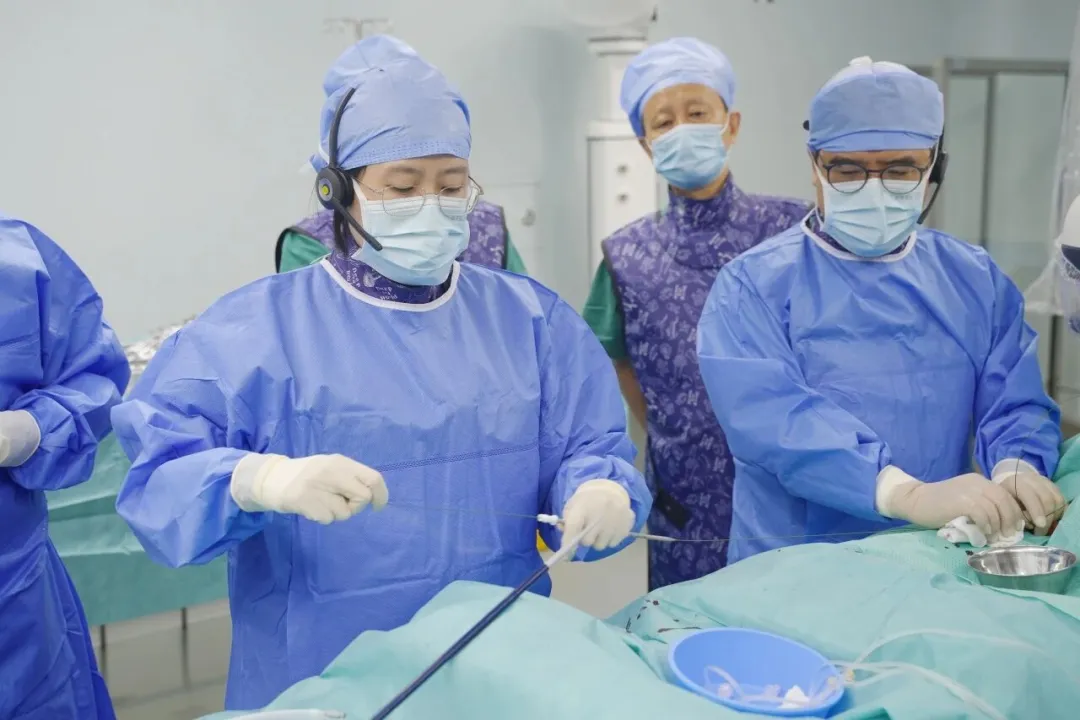
Ruijin Hainan Hospital has become a hub for the introduction of innovative cardiovascular devices. To date, the hospital has implemented more than 210 special medical devices and pharmaceuticals, including over 140 national firsts, serving tens of thousands of patients from across the country. The AVEIR™ AR2 was approved for use in the pilot zone in September 2026 and was implanted within weeks — a timeline that reflects the efficiency of Lecheng’s “pioneering pilot” pathway, which allows devices approved by major international regulators to be used clinically in China before full national registration.

For patients with symptomatic sinus node dysfunction, the arrival of the AVEIR™ AR2 at Lecheng means that a therapy designed to match the physiology of their condition — atrial pacing, without the mechanical liabilities of a transvenous system — is now within reach. It is not a cure for the underlying degeneration of the sinus node. But it is a solution that restores rhythm, reduces risk, and allows patients to return to the lives they were living before their heart began to forget how to beat.

A Call to Action

If you or someone you love has been diagnosed with sinus node dysfunction and has been told that a pacemaker is needed, it is worth asking whether a leadless atrial pacing system might be appropriate. The decision depends on many factors — the integrity of the AV conduction system, the patient’s age and activity level, the presence of other cardiac conditions — and should be made in consultation with an experienced electrophysiologist.

At Lecheng, we work with the cardiology teams at our partner institutions to provide comprehensive evaluation and access to innovative pacing technologies. If you would like to explore whether the AVEIR™ AR2 or another advanced pacing option might be right for you, please reach out.

Your trusted local gateway to Boao Lecheng International Medical Tourism Pilot Zone. We bridge the gap between global patients and world-class innovative healthcare.

LEARN MORE ABOUT US

CONTACT INFORMATION

Email: support@lechengmedical.com 

Tel: (+86) 400-118-118

For privacy reasons Google Maps needs your permission to be loaded. For more details, please see our Privacy Policy.

MEDICAL DEPARTMENTS

  • Oncology Treatment

  • Orthopedic/Rehab

  • Anti-Aging/Stem Cells

  • TCM & Wellness

  • Precision Health Screening

  • Other

© Copyright 2025 - 2026 LechengMedical.com, All Rights Reserved. | Privacy Policy | Terms of Service | Medical Disclaimer

Page load link
This website uses cookies and third party services. Settings
Ok Reject
English
Chinese
Go to Top