

Skip to content
LechengMedical LogoLechengMedical Logo
  • HOME
  • ABOUT
  • SUCCESS STORY
    • Turkish Doctor – COPD Treatment
    • Russian Professor – BNCT Treatment
    • LHON Patients from Japan & Myanmar
    • Anti-Aging & Stem Cells
    • Orthopedic & Rehabilitation
    • People Reviews
  • PRICE
    • Physical Checkup
    • Medical Tourism
    • Stem Cell Therapies
    • Double Filtration Plasmapheresis
    • Featured Special Access Products
    • LaViv Autologous Fibroblast Therapy
  • ARTICLES
    • Why Choose Boao Lecheng?
    • Hassle-Free Entry to Hainan
    • Frequently Asked Questions (FAQ)
  • MAKE APPOINTMENT

China’s First SING IMT® Implant for Macular Degeneration at Lecheng

Restoring What Was Lost: China's First SING IMT® Implant for End-Stage Macular Degeneration at Lecheng

There are moments in medicine when you realize you are witnessing something that will be written into the textbooks. I have felt that sensation only a handful of times in my career. On July 6, 2024, I felt it again — not because a life was saved, but because a particular kind of life was given back.

In an operating room at Hainan Medical University First Affiliated Hospital Lecheng Hospital (Ciming Boao International Hospital), a surgical team led by Professor Li Xiaorong of Tianjin Medical University Eye Hospital performed China’s first implantation of the Xin Mu Tai® SING IMT® — a next-generation implantable miniature telescope designed to restore central vision in patients with end-stage age-related macular degeneration. The patient was a 67-year-old man who had lost the ability to read, to recognize faces, and to navigate the world with confidence. When he left the hospital three days later, he did so seeing more than he had in years.

Understanding Age-Related Macular Degeneration

To appreciate what this surgery represents, it is necessary to understand what AMD does to a person.

Age-related macular degeneration is a disease of the macula — the central portion of the retina responsible for the sharp, detailed vision we use for reading, driving, and recognizing faces. It is the leading cause of irreversible central vision loss in adults over 50, and its prevalence increases steeply with age. In China, the prevalence of AMD is approximately 19.2% among people aged 70 to 79, rising to 32.5% among those aged 80 and older. According to the Chinese Clinical Guidelines for the Diagnosis and Treatment of Age-Related Macular Degeneration (2023), China’s AMD prevalence among people over 70 is 20.2%, and the number of patients continues to rise as the population ages.

AMD presents in two forms. The dry form, which accounts for the majority of cases, involves the gradual thinning of the macula and the accumulation of drusen — yellow deposits beneath the retina. The wet form is characterized by the growth of abnormal blood vessels beneath the retina, which leak fluid and blood, causing rapid and often severe vision loss. Both forms can progress to end-stage disease, in which the central retina becomes scarred and atrophic, leaving patients with a central scotoma — a blind spot in the middle of their visual field.

For patients with end-stage AMD, the clinical landscape has historically been bleak. Anti-VEGF injections, the mainstay of treatment for wet AMD, are most effective in earlier stages of the disease and do not restore vision that has already been lost. Laser therapy, photodynamic therapy, and nutritional supplementation may slow progression but cannot reverse established damage. Patients are typically told that the damage is irreversible and that they must learn to live with profound central vision loss. It is a diagnosis that carries not just functional limitation but a profound emotional and psychological burden.

What SING IMT® Is and How It Works

The device at the center of this milestone is a Galilean telescope that is implanted inside the eye. The Xin Mu Tai® SING IMT® is a smaller-incision, next-generation version of the implantable miniature telescope technology developed by Samsara Vision. It is a visual optical assistive device that is inserted through a scleral incision and placed in the lens capsule or ciliary sulcus, where it works in conjunction with the cornea to form a Galilean telescopic system.

The principle is elegant in its simplicity. The telescope magnifies central images by approximately 2.7 times and projects them onto healthy photoreceptors surrounding the damaged macula. This magnification effectively reduces the size of the central scotoma — the blind spot — allowing patients to use their remaining peripheral retinal function to see what they would otherwise miss. Critically, the device preserves the peripheral visual field, so patients retain their spatial awareness and orientation. They can perform daily activities — reading, recognizing faces, navigating a room — by simply moving their eyes rather than their entire head.

The surgical technique used at Lecheng combined phacoemulsification — the standard cataract removal procedure — with implantation of the SING IMT® device. The procedure was performed under peribulbar anesthesia. Professor Li Xiaorong conducted a detailed preoperative assessment of the patient’s anterior segment and fundus to ensure appropriate candidate selection and surgical planning. The device was successfully implanted, the incision healed well, and the patient’s vision improved significantly after surgery.

The Advantages Over Conventional Approaches

The conventional management of end-stage AMD is, in large part, a story of limitations. Anti-VEGF therapy is designed to stop the disease from getting worse, not to restore what has been lost. Low-vision aids — magnifiers, telescopic spectacles, electronic devices — can help, but they are external, cumbersome, and often difficult for elderly patients to use consistently. None of these approaches addresses the fundamental problem: a central retina that can no longer process images.
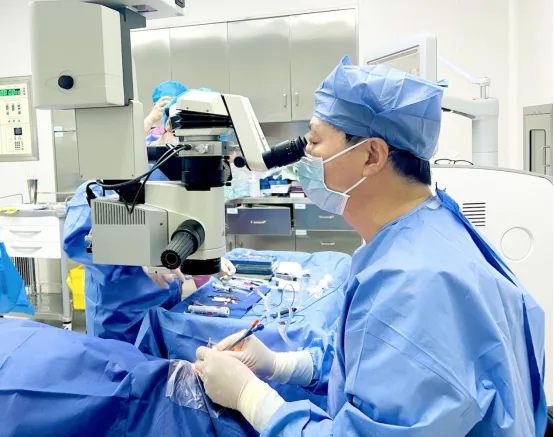
SING IMT® represents a fundamentally different approach. Rather than treating the disease process, it works with the eye’s existing anatomy to restore functional central vision. The device is implanted once and remains in place permanently. It does not require repeated injections, external equipment, or daily maintenance. For patients whose AMD has progressed beyond the point where conventional therapies are effective, it offers something that has long been absent from the clinical armamentarium: a genuine option.

The clinical evidence supports this. In a study of 35 patients with a mean age of 77.4 years, at six months post-surgery, 97.1% of patients achieved at least a one-line gain in best-corrected distance visual acuity, 68.6% achieved at least a two-line gain, and 51.4% achieved at least a three-line gain. The percentage of patients able to read at near distance increased from 28.6% at baseline to 97.1% at six months. The most frequent adverse event was corneal edema, which resolved with topical medication in all cases. A separate study of pseudophakic patients reported an average gain of 16.8 ± 10.2 ETDRS letters in corrected distance visual acuity and 13.8 ± 7.4 letters in corrected near visual acuity.

The Team Behind the Milestone

The surgery was performed by Professor Li Xiaorong, Director of Tianjin Medical University Eye Hospital and a member of the Chinese Medical Association Ophthalmology Branch’s Fundus Disease Group. Professor Li is also a Senior Clinical Scientist at the Singapore Eye Research Institute. His decision to bring this technology to Lecheng was driven by a recognition that end-stage AMD patients had been left behind by the existing therapeutic paradigm. “It was previously believed that central vision damage caused by end-stage AMD was irreversible, and there was no effective method for these patients,” Professor Li said. “SING IMT® builds a unique intraocular optical imaging system to improve central vision and enhance patients’ visual experience and quality of life. It has broad clinical application prospects”.
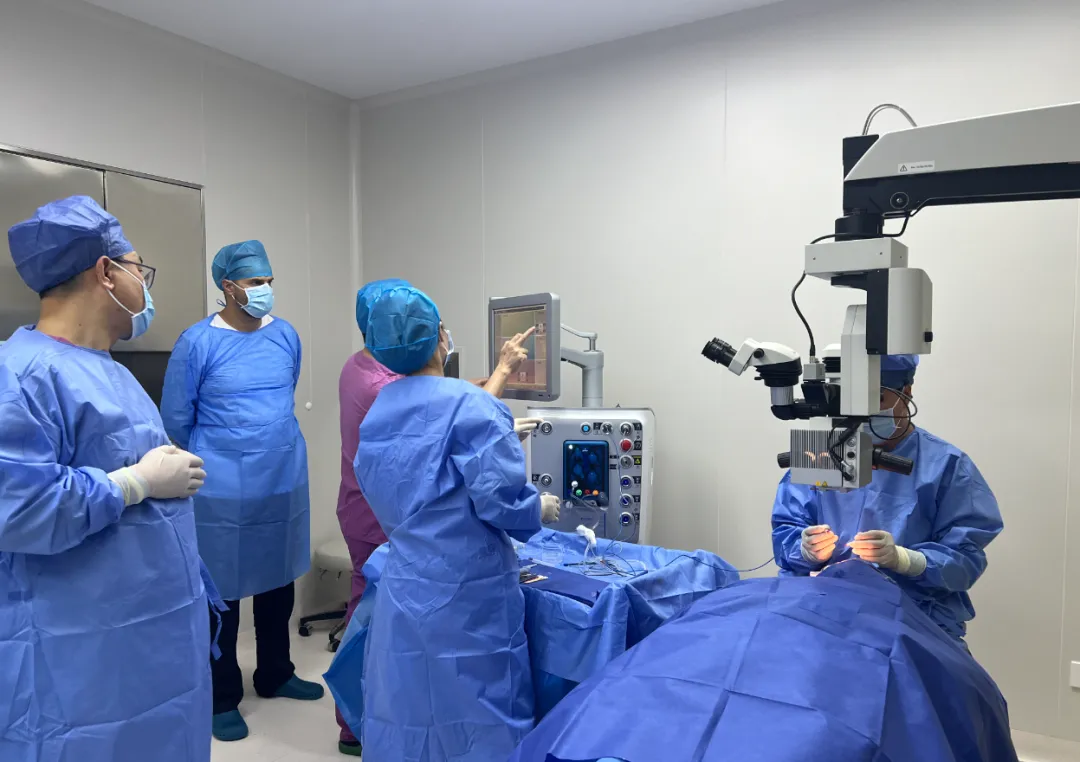
The hospital’s leadership, led by President Huang Yongyong, has been equally committed to making this technology accessible. When the first patient was discharged, President Huang personally led a farewell ceremony. The patient, a 67-year-old man, held the president’s hand and expressed his gratitude with tears in his eyes. “Thank you… thank you all,” he said. President Huang replied: “Congratulations on your discharge. Seeing you able to see this world again brings all of us great comfort. This is the power of medical progress, and the result of our collective efforts”.

The Lecheng Advantage

None of this would have been possible without the policy framework that defines the Boao Lecheng International Medical Tourism Pilot Zone. As China’s only national-level medical special zone, Lecheng is authorized to introduce and clinically apply innovative drugs and medical devices that have been approved by major international regulators — such as the U.S. FDA or the European CE mark — before they receive full approval from China’s National Medical Products Administration. This “pioneering pilot” policy allows patients in China to access cutting-edge therapies years earlier than would otherwise be possible.

For ophthalmology specifically, Lecheng has become a hub for international innovation. Multiple high-level ophthalmic institutions have established operations within the zone, completing over a thousand applications of specially approved imported ophthalmic devices and drugs. Patients with conditions ranging from cataract and glaucoma to retinal disease and corneal disorders now have access to diagnostic and therapeutic options that match international standards. The introduction of SING IMT® extends this mission to a patient population that had been largely underserved: those with end-stage AMD, for whom the existing treatment landscape offered little more than resignation.

Ciming Boao International Hospital, where the procedure was performed, has committed to continuing the introduction of cutting-edge ophthalmic technologies. “We will continue to rely on the ‘pioneering pilot’ policy advantages, strengthen cooperation and exchange with internationally advanced medical institutions, and provide Chinese physicians with a platform for valuable learning and exchange,” the hospital stated. “We will inject strong momentum into the new quality productive forces of China’s medical technology, promote progress and development, and enable more patients to benefit from the health and well-being brought by scientific and technological progress”.

Vision Is Not a Luxury

If you or someone you love has been diagnosed with end-stage age-related macular degeneration — if you have been told that nothing more can be done, that the damage is irreversible, that you should learn to live with the loss of central vision — I encourage you to explore whether SING IMT® might be an option. The device is not suitable for every patient; its efficacy depends on the specific characteristics of the retina, the stability of the disease, and the overall health of the eye. But for those who are candidates, it offers something that has been in short supply: the possibility of seeing again.

The first step is a comprehensive evaluation by an experienced retina specialist. At Lecheng, we work with the ophthalmic teams at our partner institutions, including the Ciming Boao International Hospital, to provide thorough assessment and personalized surgical planning. Our international patient services team can help coordinate your evaluation, travel, and treatment.

The patient who received China’s first SING IMT® implant left the hospital seeing more of the world than he had in years. He was not cured of macular degeneration. But he was given back something that the disease had taken from him: the ability to look at the faces of the people he loves and see them clearly.

That is what medicine, at its best, can do. Let us help you find out if it can do it for you.

Your trusted local gateway to Boao Lecheng International Medical Tourism Pilot Zone. We bridge the gap between global patients and world-class innovative healthcare.

LEARN MORE ABOUT US

CONTACT INFORMATION

Email: support@lechengmedical.com 

Tel: (+86) 400-118-118

For privacy reasons Google Maps needs your permission to be loaded. For more details, please see our Privacy Policy.

MEDICAL DEPARTMENTS

  • Oncology Treatment

  • Orthopedic/Rehab

  • Anti-Aging/Stem Cells

  • TCM & Wellness

  • Precision Health Screening

  • Other

© Copyright 2025 - 2026 LechengMedical.com, All Rights Reserved. | Privacy Policy | Terms of Service | Medical Disclaimer

Page load link
This website uses cookies and third party services. Settings
Ok Reject
English
Chinese
Go to Top