

There comes a moment in every practitioner’s career when a technology arrives that genuinely reshapes how we think about healing. For us, that moment arrived the first time we sat across from a patient whose knee had been silently deteriorating for years after a sports injury. He was in his early forties, an avid runner, yet already walking with a limp. He had tried everything: physical therapy, corticosteroid injections, hyaluronic acid supplements. Nothing worked. His MRI showed a focal cartilage defect – a hole in the smooth articular lining of his knee. And the standard advice from traditional orthopedics was bleak: manage the pain as long as you can, and prepare for a knee replacement in ten or fifteen years.
That was my low point. But a few years later, I found myself standing in the sterile processing suite of a new facility at Hainan’s Lecheng Pilot Zone, watching a biomedical engineer formulate a solution of microscopic, bead-like particles. That solution, we knew, would soon be injected into a patient’s knee to regenerate cartilage that would otherwise never grow back. That solution was CartiLife, and its arrival in China may well change everything we know about joint preservation.
What is CartiLife? A brief history and how it works
CartiLife is not just another cell therapy. It is a fourth-generation autologous cartilage cell therapy, developed by the Korean company Biosolution, that quite literally grows new cartilage from a patient’s own cells. The story begins in South Korea. In April 2019, the Korean Ministry of Food and Drug Safety (MFDS) granted CartiLife conditional approval for marketing – the first time a ready-to-use autologous chondrocyte product had reached patients in that country. Since then, it has expanded globally. In 2023, the U.S. Food and Drug Administration granted it Regenerative Medicine Advanced Therapy (RMAT) designation, a status reserved for the most promising regenerative medicines. In early 2025, Korea’s MFDS converted that conditional approval into full marketing authorization.
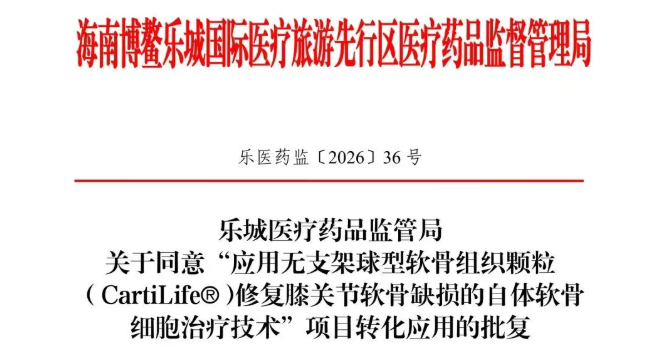
In early 2026, the Boao Lecheng International Medical Tourism Pilot Zone in Hainan officially approved the technology for clinical use at Boao International Hospital – a facility operated by Jimin Health – marking the first time CartiLife has been introduced into the Chinese market.
The technology itself is both simple in concept and sophisticated in execution. To understand it, you must first understand the problem: articular cartilage, the smooth tissue that lines the ends of our bones inside joints, has virtually no intrinsic healing capacity. It lacks blood vessels, nerves, and lymphatics, so when you damage it – by a fall in soccer, a misstep skiing, or simply years of overuse – it cannot heal itself. Traditional treatments include microfracture surgery, in which tiny holes are drilled into the bone underneath the defect to encourage bleeding and the formation of scar-like fibrocartilage. That scar tissue fills the hole, but it has poor mechanical properties and typically breaks down within a few years.
CartiLife works very differently. The physician harvests a small sample of the patient’s own healthy cartilage – about 50 to 100 milligrams – via a minimally invasive arthroscopic procedure. That sample is then shipped to a certified GMP (Good Manufacturing Practice) laboratory. Over the next four to six weeks, the chondrocytes are expanded and coaxed to form small, three-dimensional spheroids, each about 0.5 to 1.0 millimeters in diameter. These spheroids are not merely clusters of cells; they form what the developers call a “scaffold-free” construct, meaning they already contain a rich extracellular matrix (ECM) of collagen and proteoglycans that mimics the natural environment of healthy cartilage. The final formulation contains more than 90% living cells.
What is autologous chondrocyte treatment?
For those not trained in cellular medicine, the concept of autologous chondrocyte implantation (ACI) can feel abstract. So let us put it plainly: we take living cells from your own body, grow them into millions of copies, and then implant them back into the place where the cartilage has worn away – not as a simple filler but as an engine for native regeneration.
The first generation of ACI, introduced more than two decades ago, involved injecting a liquid suspension of chondrocytes under a flap of periosteum (the membrane that covers bone). That technique worked in some cases, but it was unpredictable, required two invasive surgeries, and often resulted in complications such as periosteal overgrowth, calcification, or delamination of the graft from the underlying bone. Later generations improved on the concept by embedding the cells in a scaffold – a collagen membrane or a hydrogel – that provided structural support but still required foreign materials to be left in the joint.
CartiLife represents something else entirely: a scaffold-free, three-dimensional, bead-type construct that carries the cells in a form they already recognize. In the operating room, the surgeon performs a second small arthrotomy (an opening into the joint), prepares the chondral defect by removing any remaining damaged tissue, and then simply pours the CartiLife beads into the defect. The beads, each containing millions of highly active chondrocytes in their own ECM, settle into the defect. Fibrin glue is applied over the top to hold them in place while they integrate. Over the following months, those cells begin synthesizing new type II collagen and proteoglycans, essentially rebuilding hyaline cartilage from within.
How does this differ from traditional treatments?
The difference between CartiLife and traditional microfracture surgery is like the difference between planting a garden and simply scattering seeds on asphalt. Microfracture creates fibrocartilage – a dense, disorganized scar that lacks the smooth compressive strength and low friction of native hyaline cartilage. Fibrocartilage may fill the defect, but it cannot withstand the daily pounding of walking, running, and climbing stairs. It breaks down, often within 24 to 48 months, and patients find themselves back where they started.
CartiLife, by contrast, forms hyaline-like cartilage. The cells that produce it are the same cells that live in healthy joints. Once implanted, they not only produce new matrix but also secrete anti-inflammatory signaling molecules. Researchers have found that these cytokines and miRNAs actively suppress pro-inflammatory pathways in the joint microenvironment, reducing the cycle of degradation and inflammation that drives osteoarthritis progression.
Moreover, CartiLife can be applied in a standardized way. Each square centimeter of defect is covered by one prefilled syringe, containing about 480 spherical beads and delivering between 2.0 and 5.0 million living cells per square centimeter. That level of standardization removes much of the variability that has historically plagued cartilage repair surgery, where outcomes depended heavily on the surgeon’s skill in shaping and securing the graft.
Who is eligible, and where is this performed?
Not every knee patient is a candidate. The therapy is specifically indicated for ICRS Grade III or Grade IV focal cartilage defects – meaning those that penetrate through most or all of the cartilage layer down to the subchondral bone – and for defects measuring between two and ten square centimeters in area. In practical terms, this means younger and middle-aged patients with focal, post-traumatic or degenerative defects, typically ones that have not yet progressed to end-stage osteoarthritis across the entire knee. The therapy is not intended for patients with widespread, end-stage osteoarthritis who would be better served by joint replacement.
In China, CartiLife has been approved for clinical use at Boao International Hospital, located within the Boao Lecheng International Medical Tourism Pilot Zone in Hainan Province. The approval was granted by the Lecheng Medical Drug Administration, and the therapy is implemented by the hospital’s orthopedic department. The hospital has its own GMP-compliant cell processing facility, where the cartilage samples are expanded and the CartiLife spheroids are manufactured according to the same standards as any pharmaceutical product.
What does the science actually say?
Regenerative medicine has a habit of generating more hype than evidence. So when we evaluate a new technology, our physicians look at the data, not the press releases. Fortunately, CartiLife has accumulated considerable evidence over the past several years.
The most rigorous data comes from a multi-center, active-controlled, randomized Phase 2/3 trial comparing CartiLife directly with traditional microfracture surgery. The trial enrolled 30 patients with ICRS Grade III or IV defects of the knee, randomized at a ratio of 2:1 to CartiLife or microfracture. At 48 weeks post-surgery, the CartiLife group’s MOCART scores – the key MRI-based measure of cartilage structural regeneration – were significantly higher than those of the microfracture group. Functional outcomes measured by the Lysholm score were also significantly better in the CartiLife group at 48 weeks. The authors concluded that CartiLife “can be a critical option for structural cartilage regeneration as well as improvement of patient symptoms and function”.
That trial was extended and expanded into a larger Phase 3 study in Korea, enrolling 104 patients across 19 medical centers. At 48 weeks, the CartiLife group achieved a mean MOCART total score of 55.81, compared to 46.16 in the microfracture control group – a statistically significant difference (p=0.0196). Notably, the CartiLife group maintained improvement through the 96-week follow-up, demonstrating durable structural regeneration.
Outside of the research setting, the Phase 2 U.S. trial provided further validation. Twenty patients with severe Grade III-IV defects were treated across five U.S. clinical sites, with an average age of 53 and average BMI around 30 – meaning these were not young, thin, highly selected athletes but rather middle-aged, mildly obese, real-world patients. At 48 weeks, the mean cartilage defect fill score reached 14.2 out of 20, compared to the 9-point average typically seen with microfracture. MOCART scores averaged in the 80s. That MOCART figure is especially striking when you consider that the MOCART score published in 2010 for Vericel’s MACI – an FDA-approved cartilage cell therapy – was 75.7. The difference in quality of life scores was equally compelling: KOOS Quality of Life improved from 16.8 at baseline to 52.5. These patients simply felt better, and that, in our partner hospital’s experience, is what matters most.
A personal note on what this means for our patients
I have spent enough years in musculoskeletal medicine to know that data alone does not tell the whole story. The real measure of a therapy is not the p-value or the effect size but the face of the patient who says, “I can walk my dog again,” or “I can chase my grandchild without limping.”
CartiLife matters because it offers something that traditional orthopedic surgery has never been able to provide: genuine tissue regeneration in a joint that lacks the machinery to do it on its own. For the twenty-five-year-old athlete with a traumatic chondral defect, it means a chance to return to sport without knowing that he will need a knee replacement at age forty. For the forty-five-year-old weekend warrior with a two-centimeter defect behind the patella, it means a way to stay active without the steady, grinding progression toward osteoarthritis.
And for us, as practitioners, it means we can finally offer something other than “live with the pain” or “wait for a joint replacement.” That is a profound shift, and it is one that I do not take lightly.
So here is my call to you, whoever you may be: if you have a focal cartilage defect – a hole in the smooth surface of your knee that has been causing you pain, swelling, or giving way – and if you have been told that nothing can be done aside from pain management or eventual joint replacement, we ask you to reconsider. The science of cartilage regeneration has advanced, and those advances are now available at Boao International Hospital in the Lecheng Pilot Zone. The treatment is not a miracle, and it is not cheap. But it is a real option, backed by randomized trial data and used successfully in thousands of patients worldwide.
We invite you to reach out, not to buy a product, but to have a conversation. We want to see your MRI report. We want to understand your history, your activity level, and your goals. And we want to give you an honest assessment of whether CartiLife is right for you.
To schedule a consultation, please contact the orthopedic department at Boao International Hospital, or reach us directly at [insert clinic phone number or email address]. We look forward to hearing your story.
