

跳至内容
LechengMedical 标识LechengMedical 标识
  • 主页
  • 关于
  • 成功案例
    • 土耳其医生——慢性阻塞性肺病治疗
    • 俄罗斯教授——硼中子俘获疗法
    • 来自日本和缅甸的LHON患者
    • 抗衰老与干细胞
    • 骨科与康复
    • 用户评价
  • 价格
    • 体检
    • 医疗旅游
    • 干细胞疗法
    • 双重过滤血浆置换术
  • 文章
    • 为什么选择博鳌乐城?
    • 轻松入境海南
    • 常见问题解答 (FAQ)
  • 预约

零关税Y-90微球:乐城医院肝癌治疗的新希望

First three patients benefit from Hainan Free Trade Port policy, with treatment costs reduced by RMB 50,000 per person

Recently, three liver cancer patients successfully underwent Yttrium-90 (Y-90) glass microsphere treatment at the Ruijin Hospital Hainan Hospital (Ruijin Hainan Hospital) affiliated with Shanghai Jiao Tong University School of Medicine, located in the Boao Lecheng International Medical Tourism Pilot Zone in Hainan. This marks the first time that Y-90 glass microsphere treatments have been performed under Hainan Free Trade Port’s “zero-tariff” policy. The implementation of this policy has directly reduced the treatment cost of the medical device by RMB 50,000 per patient, signaling a significant step forward in improving both the accessibility and affordability of advanced international oncology therapies in Lecheng.

Inside the Procedure: Precision “Detonation” of Complex Liver Cancers

Inside the operating room, Dr. Wang Zhongmin, Chief Interventional Radiologist at Ruijin Hospital Shanghai, stood at the console, his expression focused and steady as the regular beeping of the monitors filled the room. As he carefully withdrew the last microcatheter, he let out a quiet breath—the procedure had gone smoothly.

Among the first patients to benefit from the “zero-tariff” Y-90 glass microspheres, two had traveled from Shanghai specifically to be treated by Dr. Wang. One of them had primary liver cancer with a massive tumor in the right lobe, richly vascularized and inoperable by conventional surgical resection. “We hope that Y-90 therapy can serve as a bridge to downstage the tumor, and eventually create an opportunity for surgical resection,” Dr. Wang explained.

The second patient from Shanghai presented an even more complex challenge. Dr. Wang noted that this patient had already undergone multiple interventional treatments, combined with targeted therapy and chemotherapy, all with poor results—a typical case of advanced, multi-treated hepatocellular carcinoma. Repeated treatments had led to extremely poor vascular conditions and complex anatomy. Because the tumor was located in the left lobe and fed by multiple aberrant arterial branches, the team performed superselective catheterization one by one, ensuring that the microspheres entered only the tumor-feeding vessels while sparing healthy liver tissue. The procedure was akin to navigating a dense spiderweb of blood vessels with millimeter precision. “For patients with unresectable liver cancer, Y-90 offers a new pathway,” said Dr. Wang.

The third case was a local patient from Hainan, operated on by Dr. Lin Fuhuang, Chief of Interventional Radiology at Hainan General Hospital. The patient was diagnosed with primary liver cancer after being admitted with fever—the tumor measured up to 14 cm in diameter, a giant hepatocellular carcinoma that precluded conventional surgical options. Dr. Lin explained that Y-90 glass microsphere therapy is a form of selective internal radiation therapy that delivers radioactive microspheres directly into the tumor via an interventional approach, releasing high-energy beta rays to precisely kill cancer cells. This could potentially create a window for surgical resection or liver transplantation.

Unveiling the “Nuclear Weapon”: 2.5 mm of Targeted Detonation

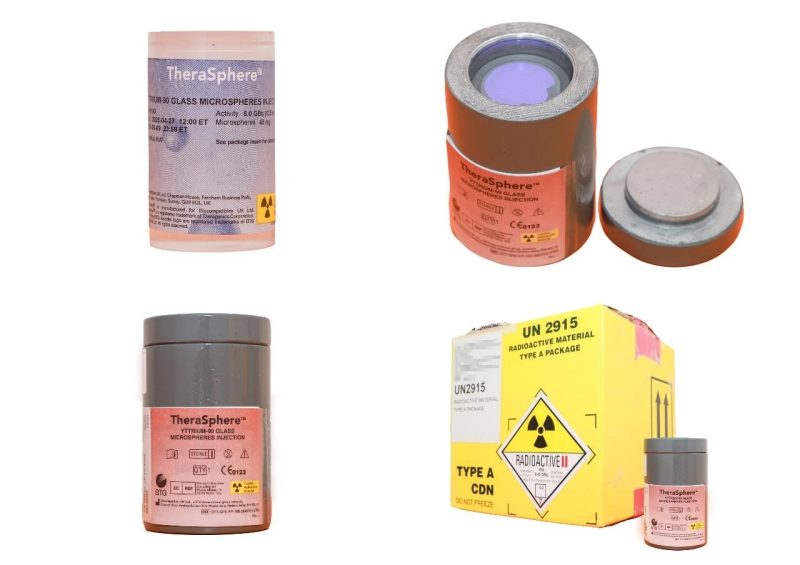
Y-90 glass microsphere therapy is the world’s first FDA‑approved microsphere technology for primary liver cancer, and has been used clinically in over 50 countries and regions for more than 20 years. It is often described as the “nuclear weapon” of interventional oncology for liver cancer.

Y-90 is a radioactive isotope with a half‑life of just 64 hours. Its beta radiation is high‑energy but has a very short tissue penetration depth—on average only 2.5 millimeters. Scientists encapsulate Y‑90 inside glass microspheres measuring just 20–30 micrometers in diameter—about one‑third the width of a human hair. Through a minimally invasive interventional procedure, the physician delivers millions of microspheres directly into the blood vessels feeding the liver tumor. The microspheres become lodged in the tumor’s capillary network and continuously emit beta radiation from within, acting like a “precision detonation” that kills cancer cells efficiently while sparing surrounding healthy liver tissue and adjacent organs, thanks to the shallow penetration depth of just 2.5 mm.

The entire treatment does not require open surgery. The physician makes a tiny incision—about the size of a pencil tip—in the femoral artery of the groin or the radial artery of the wrist, advances a microcatheter under DSA imaging to the hepatic artery branch supplying the tumor, and then slowly injects the Y‑90 microspheres. The microspheres are carried by the blood flow and become selectively trapped in the tumor’s capillary bed. The procedure typically takes about one hour, and patients are usually discharged after 1–2 days of observation.

Y-90 glass microsphere therapy is primarily indicated for unresectable liver cancer, including both hepatocellular carcinoma and metastatic liver cancer, and can also be used in patients with portal vein tumor thrombosis. It effectively shrinks tumors, enabling previously inoperable patients to become candidates for curative resection, or serves as a bridge to liver transplantation.

Lightning‑Fast “Delivery”: Import Process Streamlined to Hours

Because Y‑90 glass microspheres are radioactive pharmaceuticals with a half‑life of only 64 hours, logistics and customs clearance present an extraordinary challenge. “The product must move seamlessly from production to administration,” explained Peng Sinan, Customs Manager at the Boao Public Bonded Warehouse. “If the international shipping, customs clearance, warehousing, and delivery to the hospital cannot be completed within a very tight timeframe, the potency will be greatly reduced or even lost.”

To ensure the safe and timely arrival of this special imported medical device, the Lecheng bonded warehouse team began preparing well in advance—completing system entries, document reviews, and airport pickup arrangements before the cargo even left the country of origin. When the shipment landed in Hainan, the waiting team immediately processed customs clearance, transport, and acceptance inspection. “From the moment the goods arrived in Hainan to customs declaration, inspection, and delivery to the hospital, the entire process took only half a day,” Peng Sinan said with pride.

Cost Breakthrough: Zero Tariffs and Specialty Insurance “Cushion” the Expense

While the technology is advanced, cost has been a major barrier preventing broader patient access. Imported Y‑90 microspheres carry high tariffs and logistics expenses, making treatment expensive. That situation is now beginning to change.

Under the “Zero‑Tariff Policy for Drugs and Medical Devices in Hainan Free Trade Port,” jointly issued by the Ministry of Finance, the National Health Commission, the General Administration of Customs, the State Taxation Administration, and the National Medical Products Administration, qualified medical institutions registered and operating in the Boao Lecheng Pilot Zone can import eligible pharmaceuticals and medical devices free of import tariffs, import value‑added tax, and consumption tax. This policy has been operating smoothly since its first implementation on December 31, 2024.

Dr. Jin Jiabin, Vice President of Ruijin Hainan Hospital, noted that the high cost of Y‑90 glass microspheres had previously deterred many patients. “Thanks to the implementation of Hainan Free Trade Port’s zero‑tariff policy, each patient now saves RMB 50,000 in tax costs,” Dr. Jin said. “Our hospital passes that full saving directly on to patients.”

On the insurance front, Y‑90 glass microsphere therapy has been included in Lecheng’s Global Special Drug Insurance as well as certain city‑based supplemental health insurance plans (Huiminbao). In some cases, reimbursement rates can reach 80%, meaning that with the zero‑tariff benefit combined with insurance coverage, out‑of‑pocket costs for patients will be further reduced.

Since the first Y‑90 procedure was performed in Lecheng in May 2024, nearly 100 liver cancer patients have received this therapy at the pilot zone, with overall outcomes proving highly effective. With the zero‑tariff policy now in effect and insurance coverage continuing to expand, this international innovation is expected to become more widely accessible across the Lecheng Pilot Zone.

Patient Access Information

Ruijin Hainan Hospital has streamlined its entire treatment pathway for patients coming from outside Hainan: after a confirmed diagnosis at their local hospital, patients can contact Ruijin Hainan Hospital in advance to schedule the procedure. During the waiting period for individualized Y‑90 glass microsphere customization and dedicated delivery, patients can complete all preoperative examinations and the 99mTc‑MAA pre‑treatment evaluation at their original hospital—eliminating the need for long‑distance travel and waiting in Hainan. Once admitted to Ruijin Hainan Hospital, the procedure is performed by the experienced team from Ruijin Hospital Shanghai or the patient’s original specialist team. Post‑procedure follow‑up can be coordinated with the local hospital, making the entire process efficient and convenient while greatly reducing travel time and costs.

您值得信赖的博鳌乐城国际医疗旅游试点区本地门户。我们致力于连接全球患者与世界一流的创新医疗服务。.

了解更多关于我们的信息

联系信息

电子邮件: support@lechengmedical.com 

电话:(+86) 400-118-118

出于隐私原因,Google Maps 需要您的许可才能加载。. 更多详情请参阅我们的 Privacy Policy。.

医疗部门

  • 肿瘤治疗

  • 骨科/康复

  • 抗衰老/干细胞

  • 中医与健康

  • 精准健康筛查

  • 其他

© 2025-2026 LechengMedical.com 版权所有,保留所有权利。 隐私政策 | 服务条款 | 医疗免责声明

页面加载链接
本网站使用cookies和第三方服务。. 设置
好的 拒绝
Chinese
English
返回顶部
