

For years, I have watched patients walk into my consultation room with the same resigned expression. They have tried the minoxidil foams, the finasteride pills, the laser combs. Some have even gone through the pain and expense of traditional hair transplants—only to find that their donor supply was insufficient, or that the transplanted hair continued to thin. And then there are the patients for whom none of these options were ever viable: those with scarring alopecia, those with advanced androgenetic alopecia and no donor hair left, those whose hair loss was caused by burns or trauma.
“Is there really nothing else?” they ask. For years, I had to say no.
But today, thanks to the Boao Lecheng International Medical Tourism Pilot Zone, I can finally offer a different answer. Over the past few years, Lecheng has introduced a suite of international hair restoration technologies that go far beyond what traditional medicine has been able to offer. These are not incremental improvements—they are paradigm shifts. And as someone who has spent years watching patients struggle with the limitations of conventional treatments, I want to share what these new options mean.
Understanding Hair Loss: The Numbers and the Science
Hair loss is a remarkably common condition. In China alone, more than 250 million people are affected by some form of alopecia—roughly one in every six individuals. The most common form is androgenetic alopecia, also known as pattern baldness. In men, it typically presents as receding hairlines and thinning at the crown; in women, it manifests as diffuse thinning over the top of the scalp. According to epidemiological data, the prevalence of androgenetic alopecia in China is 21.3% in men and 6% in women—affecting a total of approximately 170 million people.
The underlying mechanism varies by condition, but in androgenetic alopecia, the primary driver is genetic sensitivity to dihydrotestosterone (DHT), a metabolite of testosterone. DHT binds to androgen receptors in hair follicles, shortening the anagen (growth) phase and progressively miniaturizing the follicle until it produces only a fine, vellus-like hair—or stops producing hair altogether. Other forms of hair loss include telogen effluvium (stress-related shedding), alopecia areata (an autoimmune condition), scarring alopecias (in which inflammation destroys the follicle), and traction alopecia (caused by prolonged tension on the hair).
One of the most common questions I hear is: “How much hair loss is normal?” On average, a healthy person sheds between 50 and 100 hairs per day. This is part of the natural hair cycle: each follicle goes through a growth phase (anagen, lasting 2–6 years), a transitional phase (catagen, a few weeks), and a resting phase (telogen, about 4 months), after which the hair falls out and the cycle begins anew. When shedding exceeds 100 hairs per day consistently, or when hair does not regrow, it may indicate pathological hair loss.
One simple self-assessment is the pull test. After not washing your hair for three to five days, gently grasp a small bundle of approximately 40–60 hairs between your thumb and forefinger and pull slowly from the root to the tip. Repeat this in different areas of the scalp. If more than two to three hairs come out with each pull, it may indicate active shedding. A more rigorous method is the 24‑hour hair collection method, in which all shed hairs are collected over a 24‑hour period—including those from pillows, combs, and during washing. If the total exceeds 100 hairs, further evaluation is warranted.
The Limitations of Traditional Treatments
To understand why the new technologies at Lecheng are so significant, it helps to first understand what patients have been up against. Traditional treatments fall into four broad categories:
Topical Minoxidil. Minoxidil is a vasodilator that prolongs the anagen phase of the hair follicle. It is available over-the-counter and is effective in some patients, particularly those with early-stage androgenetic alopecia. However, it requires twice‑daily application indefinitely—if you stop, any regrown hair will fall out within a few months. Common side effects include scalp irritation, contact dermatitis, and, in some cases, unwanted facial hair growth (hirsutism). Compliance is a major issue; many patients simply cannot maintain the regimen long-term.
Oral Finasteride. Finasteride is a 5‑alpha reductase inhibitor that blocks the conversion of testosterone to DHT. It is highly effective in slowing hair loss and promoting regrowth in many men, but it comes with a significant burden: sexual side effects, including reduced libido and erectile dysfunction, are reported in a notable percentage of users. These side effects can persist even after discontinuation in some cases, and the drug is not approved for use in women of childbearing age due to teratogenic risks. For younger patients, the prospect of taking a daily medication with sexual side effects is often a deal‑breaker.
Physical therapies. Low‑level laser therapy (LLLT) and other physical modalities are sometimes used as adjunctive treatments. While they may have mild stimulatory effects, the evidence for substantial regrowth is limited, and they are rarely sufficient as monotherapy.
Hair transplantation. Traditional hair transplant surgery—whether follicular unit transplantation (FUT) or follicular unit extraction (FUE)—involves harvesting healthy hair follicles from the donor area (usually the back of the scalp) and implanting them into balding areas. For patients with sufficient donor hair, this can be highly effective. But the limitations are substantial: it requires a healthy supply of donor follicles; it is invasive, with risks of pain, swelling, infection, and scarring; it is expensive; and it does not prevent native hair from continuing to thin around the transplanted follicles, often requiring ongoing medical therapy. Most critically, for patients with extensive hair loss, scarring alopecia, or conditions in which the follicles themselves are destroyed, traditional transplantation is simply not an option.
These limitations have left a vast population of patients with no satisfactory solution. And that is precisely where Lecheng’s innovations come in.
Medicap® (美迪凯): Artificial Hair for Irreversible Loss
In December 2025, the Medicap Hair artificial hair implantation system made its China debut at Boao Super Hospital in Lecheng. Medicap is an Italian technology that uses biocompatible artificial hair fibers—not the patient’s own follicles—to restore density. The fibers are made from a material that is designed to integrate naturally with the scalp and match the patient’s native hair in color, texture, and movement.
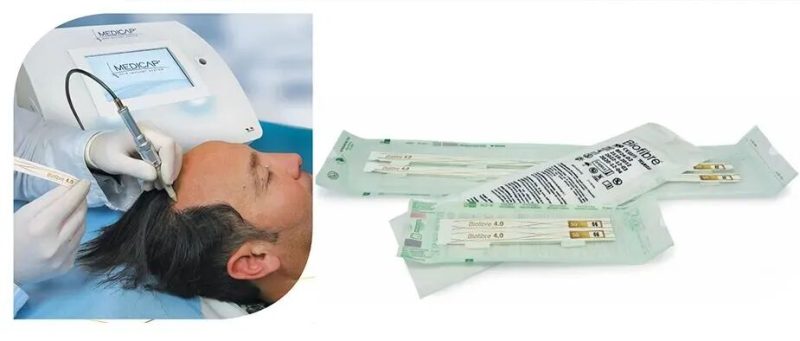
What makes Medicap truly transformative is its independence from donor hair. Traditional transplantation requires a supply of healthy autologous follicles; Medicap does not. For patients with advanced androgenetic alopecia who have exhausted their donor supply, for patients with scarring alopecia where follicles have been destroyed by inflammation, for burn victims, and for those with other forms of irreversible hair loss, Medicap offers something that has never been available before: a viable, effective option.
The procedure is performed under local anesthesia, is minimally invasive, and delivers immediate, visible results—no waiting months for transplanted follicles to grow. The artificial fibers are implanted individually, allowing for highly personalized density and distribution. Patients can resume normal activities quickly, and the results are stable and durable.
One patient who underwent the procedure described it simply: “The implantation time was very short, and the results were excellent—it looks no different from real hair.” For someone who has lived with visible hair loss for years, that is not a small thing.
Hairstetics: Synthetic Hair Implants for Female Androgenetic Alopecia
In August 2024, Lecheng introduced another groundbreaking technology: the Hairstetics non‑absorbable polyamide hair implant system, developed in Israel. This system is specifically designed for women with androgenetic alopecia—a population that has long been underserved by traditional hair restoration.
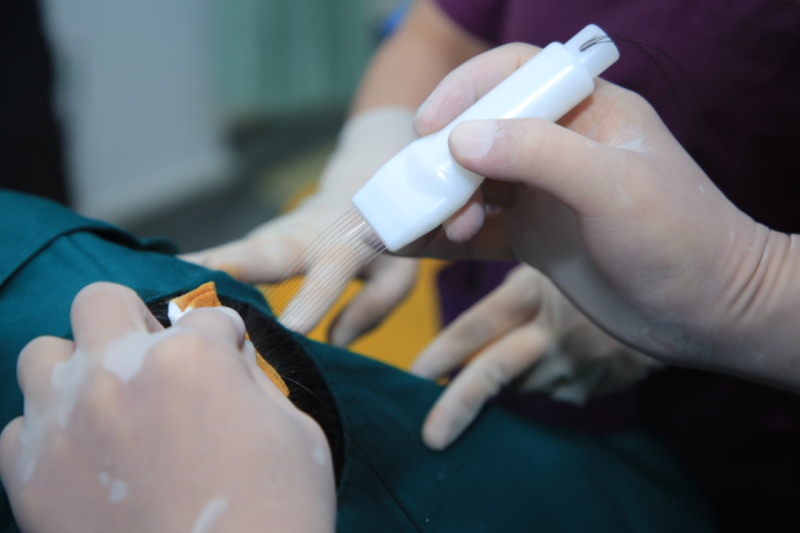
Hairstetics uses pre‑loaded, non‑absorbable polyamide (nylon) sutures housed in disposable cartridges. Each implant consists of a nitinol anchor and a polyamide monofilament. The device delivers the implant through a tiny needle that punctures the scalp, anchoring the synthetic hair in place. The procedure is minimally invasive, performed under local anesthesia, and is immediately effective—there is no waiting period for hair to grow, and no need to shave the existing hair.
One of the most distinctive features of Hairstetics is its reversibility. Unlike traditional transplantation, in which follicles are permanently moved, Hairstetics implants can be removed if desired. This gives patients a level of flexibility and control that is simply not possible with conventional surgery. The implants can also be placed in multiple sessions, allowing for gradual, customized density buildup.
The system received its Asian debut in Lecheng, with the first eight patients treated at Boao Luyi Hospital. For women with androgenetic alopecia—a condition that affects 6% of Chinese women—Hairstetics represents a new frontier.
CARETOPIC®: The First Topical Finasteride Spray
For patients who are not ready for surgical or implant-based interventions, but who find oral finasteride’s side effect profile unacceptable, CARETOPIC® offers a middle ground. CARETOPIC is the world’s first topical finasteride spray for the treatment of male androgenetic alopecia. It is approved for use in men aged 18 to 41 with mild‑to‑moderate male pattern hair loss.
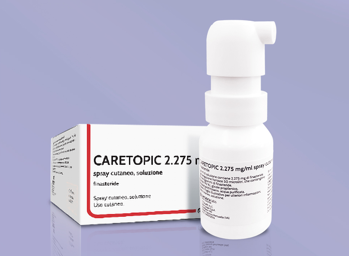
The key innovation is delivery. CARETOPIC uses a proprietary hydroxypropyl chitosan (HPCH) technology that delivers the active ingredient directly to the dermal papilla—the metabolic center of the hair follicle. The spray deposits finasteride precisely where it is needed, inhibiting type II 5‑alpha reductase and reducing local DHT production. Because the drug is applied topically rather than ingested, systemic exposure is more than 100 times lower than with oral finasteride. This dramatically reduces the risk of the sexual side effects that have made oral finasteride so problematic for many patients.
The treatment is applied once daily and typically requires three to six months of use before visible results appear. CARETOPIC has already received marketing authorization in Luxembourg, Italy, Germany, and Portugal, and its global first application was performed in Lecheng at Boao Yiling Life Care Center.
For young men who are reluctant to take a daily pill with sexual side effects, CARETOPIC represents a genuinely new option—one that works through the same mechanism as oral finasteride but with a vastly improved safety profile.

Regena (瑞杰娜): Autologous Micro‑transplantation
Together, these four technologies—Medicap, Hairstetics, CARETOPIC, and Regena—cover the full spectrum of hair loss severity and etiology. From mild‑to‑moderate androgenetic alopecia in young men to advanced, irreversible hair loss in both men and women, there is now a Lecheng‑available option that did not exist just a few years ago.
Why Lecheng? The Power of “Pioneering Pilot”
The common thread running through all of these technologies is Lecheng itself. Established in 2013 as China’s only national‑level medical special zone, Lecheng was designed with a clear mission: to achieve “three synchronizations” with international advanced standards—in medical technology, equipment, and pharmaceuticals. The pilot zone allows innovative drugs and devices that have already been approved by major international regulators to be used clinically in China before they receive full national approval.
This is not a theoretical exercise. To date, Lecheng has introduced more than 560 international innovative pharmaceuticals and medical devices for “China‑first use,” working with over 180 pharmaceutical and device companies from more than 20 countries. The zone now has more than 30 operational medical institutions. And the results for patients are tangible: they no longer need to travel abroad to access the world’s most advanced treatments.
As someone who has watched the zone grow from a bold policy experiment into a functioning ecosystem of cutting‑edge medicine, I can say with confidence that the hair restoration technologies now available in Lecheng are not incremental improvements. They are the kinds of leaps that redefine what is possible.
A Call to Action: Your Hair, Your Options
If you are one of the millions of people who have tried the standard treatments and found them wanting—if you have been told that your hair loss is “too advanced” for transplantation, or if you have been unwilling to accept the side effects of oral finasteride—I encourage you to take a fresh look. The landscape has changed.
At Lecheng, we have the technologies. We have the regulatory framework. And we have the clinical expertise to deliver these treatments safely and effectively. Whether you are a candidate for Medicap’s artificial hair, Hairstetics’ synthetic implants, CARETOPIC’s topical spray, or Regena’s cellular approach, the first step is a comprehensive evaluation.
I invite you to reach out to our international patient services team. We will review your medical history, assess your pattern and cause of hair loss, and help you understand which of these innovative options might be right for you. No pressure, no sales pitch—just a honest, evidence‑based conversation about what is possible.
Hair loss is not just a cosmetic issue. It affects how we see ourselves and how we move through the world. For too long, the answer has been “learn to live with it.” At Lecheng, we believe there is a better answer.
Let us help you find it.


